Sustainable Seaweed Resource Management
Acadian Seaplants' Best Practices
Our company is an ardent guardian of the marine environment. Decades of research has proven that properly managed, wild seaweeds are a rapidly renewable marine resource. We carefully oversee the ecosystem involving both marine plants and other marine life in our management practices and we support government licensing of harvest territories to ensure industry accountability and the sustainability of the valuable seaweed resource and its ecosystem.
As a testament to the company's well-managed harvesting operations, it has been granted long-term government leases ranging from 15 – 20 years in Nova Scotia and New Brunswick, Canada. The company has proven to government and community stakeholders that our resource management practices, backed by peer-reviewed scientific evidence, ensures the sustainability of the resource and ecosystem.
To implement the company's sustainable resource management program we employ a team of well-trained and experienced seaweed resource managers as well as a world-renowned Marine Biologist, Dr. Raul Ugarte, to apply exacting and comprehensive marine management procedures, testing and controls over all of our harvesting territories.
read more»
Resource Science at Acadian Seaplants is the responsibility of Dr. Raul Ugarte.
read more»
Our company's Resource Management Program is complex, consultative, comprehensive and includes all the procedures and controls necessary to ensure government and community support for the sustainable harvest of
Ascophyllum nodosum.
Strictly Enforced Guidelines
All self-employed fisher-harvesters who sell their seaweed harvests to Acadian Seaplants Limited follow a strict set of company-enforced harvesting guidelines. These mandatory guidelines include federal, provincial, state and our own procedures. Guideline topics include: harvesting technique, equipment maintenance, cutting height, by-catch, holdfast and harvest reporting. Safety and small boat operation training is also provided.
Harvest Method
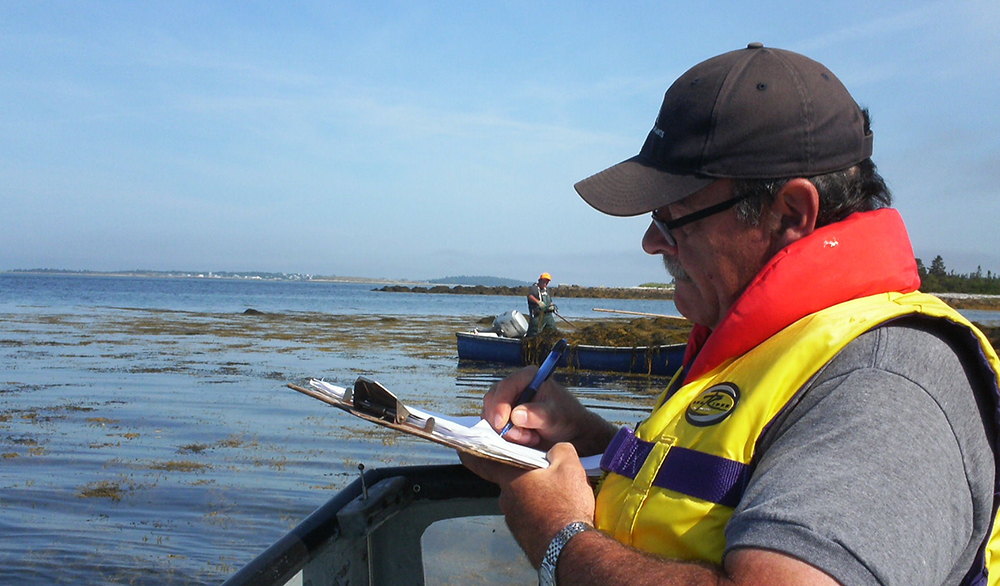
Fisher-harvesters use a small, 4-5 ton boat from which they conduct their hand-harvesting activity.
The harvest of
Ascophyllum nodosum (Rockweed) is also managed using the company-approved cutter rake. This tool was specifically designed to minimize damage to the resource and substrate through minimal holdfast removal and controlled cutting height. Because the harvest is conducted from a constantly shifting boat that moves as the tide and currents takes it, ensures that the rockweed plants are harvested in a pruning fashion. This process leaves more than ample canopy for other inter-tidal inhabitants, allowing a rapid regeneration of harvested and suppressed shoots, and minimizing the disturbance of the habitat architecture.
view more »
Safety and Training
In addition to our experienced resource personnel, we also invite government and other agencies to participate in training exercises to ensure the fisher-harvesters receive comprehensive instruction before they start their harvest season. The training includes familiarization with boat handling, tides, and currents of the Bay of Fundy, South West Nova Scotia and along the coast of Maine, the proper use of harvesting equipment and harvesting technique. On-the-water instruction is also conducted through the partnering of inexperienced harvesters with experienced fishers who provide them with additional training in proper harvesting technique, boat handling at the harvest site, proper boat loading procedures and the safe transportation of the harvest to landing sites.
Compliance Policy & Monitoring

Compliance monitoring of harvesters and their equipment is conducted on a daily basis by resource management and manufacturing staff in accordance with Government Regulations and Company Guidelines. Our on-the-water inspection is the best method to ensure compliance and keeps field staff in close contact with all harvesters to ensure that responsible harvest actions are followed. Also, compliance monitoring and reporting is conducted on a regular basis through random inspections of harvesting equipment and harvest activity locations. Any incidents of non-compliance are reported. These compliance reports are reviewed each month by senior management and safety personnel.
Area Based Management
The seaweed resource along the maritime shore is divided into harvesting sectors where harvest quotas are assigned annually. These quotas are based on annual surveys carried out on our resource. There is a total of 274 harvesting sectors under Acadian Seaplants Limited leases. The division of the resource into harvesting sectors facilitates the control of the harvest, especially the fishing effort.
Exploitation Rates
The company observes conservative exploitation rates within its leases, ranging from 17% in New Brunswick to 25% in Nova Scotia. These exploitation rates represent only 35 - 45% of the resource's annual re-growth and is a precautionary approach to reduce habitat modifications.
By-catch
By-catch is the associated fauna harvested with the
Ascophyllum nodosum plants. We have a permanent monitoring program that takes place aboard the fishing boats, which provides information on the proportion of animals being harvested as by-catch by the harvesters. The information indicates that minimum densities of organisms are caught with the rake. Most of them are small amphipods and isopods and a minor proportion of periwinkles – many of which are returned to the water when harvest is landed.
Cut Height
A minimum plant cut height is mandatory in the harvest of rockweed. Cut height is monitored directly on the beds during and after the harvest season. Data collected during the last 15 years indicate that the average cut height of plants in Acadian's territories is over 40 cm.
Mortality
Mortality (measured as holdfast incidence) is monitored both, directly from the harvesters' boats and at the company's drying facilities. Each harvest location is sampled several times during the harvest season to detect potential problems and to facilitate immediate action if required.